The Simplest Way to Build Influence as a New Engineer: Write Release Notes Nobody Asked For
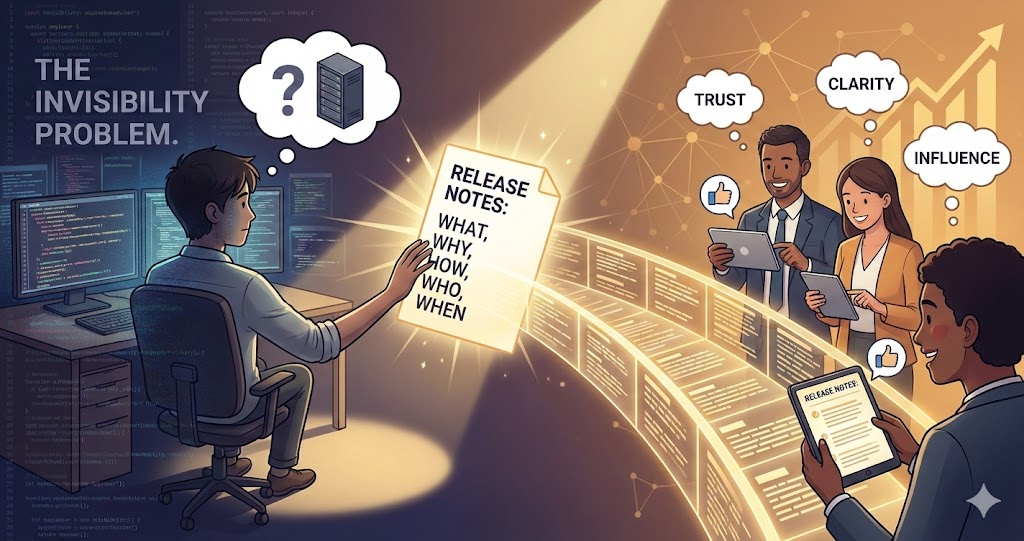
When I joined my current company, I was the new guy on a platform team. I had opinions about architecture. I had ideas about how to improve things. None of that mattered yet because nobody knew who I was.
Three months later, I was the person stakeholders pinged directly with questions. Partners described me as someone who could “translate what’s happening under the hood.” My manager cited specific feedback about my communication in my performance review.
What changed? I started writing release notes. Religiously. For everything I shipped.
Nobody asked me to do this.
The Invisibility Problem
Here’s what nobody tells you when you start a new role: your code is invisible.
You might ship something that saves the company money, unblocks three teams, or prevents production incidents. But unless someone is actively watching your pull requests, they’ll never know. Your work doesn’t speak for itself—it doesn’t speak at all.
Meanwhile, you’re trying to build trust with stakeholders who have no context on your capabilities. You’re forming opinions about the platform, but you haven’t earned the credibility to voice them yet.
Most engineers wait for this to resolve itself. They assume that if they do good work long enough, people will eventually notice.
Some do. Most don’t.
Release Notes as a Visibility Strategy
Within my first few weeks, I shipped a feature that let teams run independent jobs concurrently instead of waiting in a single queue. Useful? Yes. Visible? Only if I made it visible.
So I wrote it up:
WHAT: Concurrent job runs for data pipelines.
WHY: Independent models were getting stuck behind heavier jobs, delaying downstream reporting.
HOW: Teams can now specify separate queues in their config. Jobs in different queues run in parallel.
WHO: All teams can use this immediately.
WHEN: Live in dev and QA, production rollout next week.
Then I posted it in our team channel.
That’s it. Five sections. Took maybe fifteen minutes to write.
But here’s what that fifteen minutes bought me: every team that benefited from that feature knew exactly who shipped it and why. When they had questions, they came to me. When they had feedback, they came to me. When adjacent problems came up, I was already in the conversation.
What Makes Release Notes Actually Work
I’ve refined this over the past year. A few things I’ve learned:
Structure creates trust. I use the same format every time—WHAT, WHY, HOW, WHO, WHEN. People learn to scan it quickly. They know where to find the information they need. Predictability is a feature.
Explain the why, not just the what. Engineers love to document features. Stakeholders want to know why they should care. “Reduced time-travel window from 7 to 3 days” means nothing. “Reduced time-travel window to cut storage costs—you still have 10 days total to recover deleted tables” tells them what they actually need to know.
Anticipate questions. I started adding FAQ sections for anything that might cause confusion. “What if I’m already using feature X?” “What happens to my existing config?” This cuts down on back-and-forth and shows you’ve thought through the edge cases.
Write like a human. My notes include the occasional joke. One announcement about storage cleanup referenced a Disney movie. Another warned that “with great power comes great responsibility.” This isn’t unprofessional—it’s memorable. People actually read notes that don’t feel like legal documentation.
Ship the notes with the feature. Not a week later. Not when you “have time.” The release note is part of the release. If it’s not documented, it didn’t happen.
The Compound Effect
Here’s what surprised me: the influence compounds.
Each release note is a small deposit in a credibility account. Individually, they’re just documentation. Collectively, they become a track record that’s visible to everyone—your manager, your skip-level, partner teams, future collaborators.
When it came time for my performance review, my manager didn’t have to guess what I’d accomplished. The receipts were all there, timestamped, in public channels.
When I started proposing larger architectural changes, I wasn’t some new person with opinions. I was the person who’d been consistently shipping and communicating for months.
A simple example flow
Here’s how the release note process maps to any feature:
Start This Week
If you’re new to a role or just feeling invisible in your current one—try this:
- Ship something this week (even something small)
- Write it up in a structured format
- Post it where stakeholders will see it
- Repeat
You don’t need permission. You don’t need a fancy template. You just need to make your work visible.
The best time to start was your first week. The second best time is now.